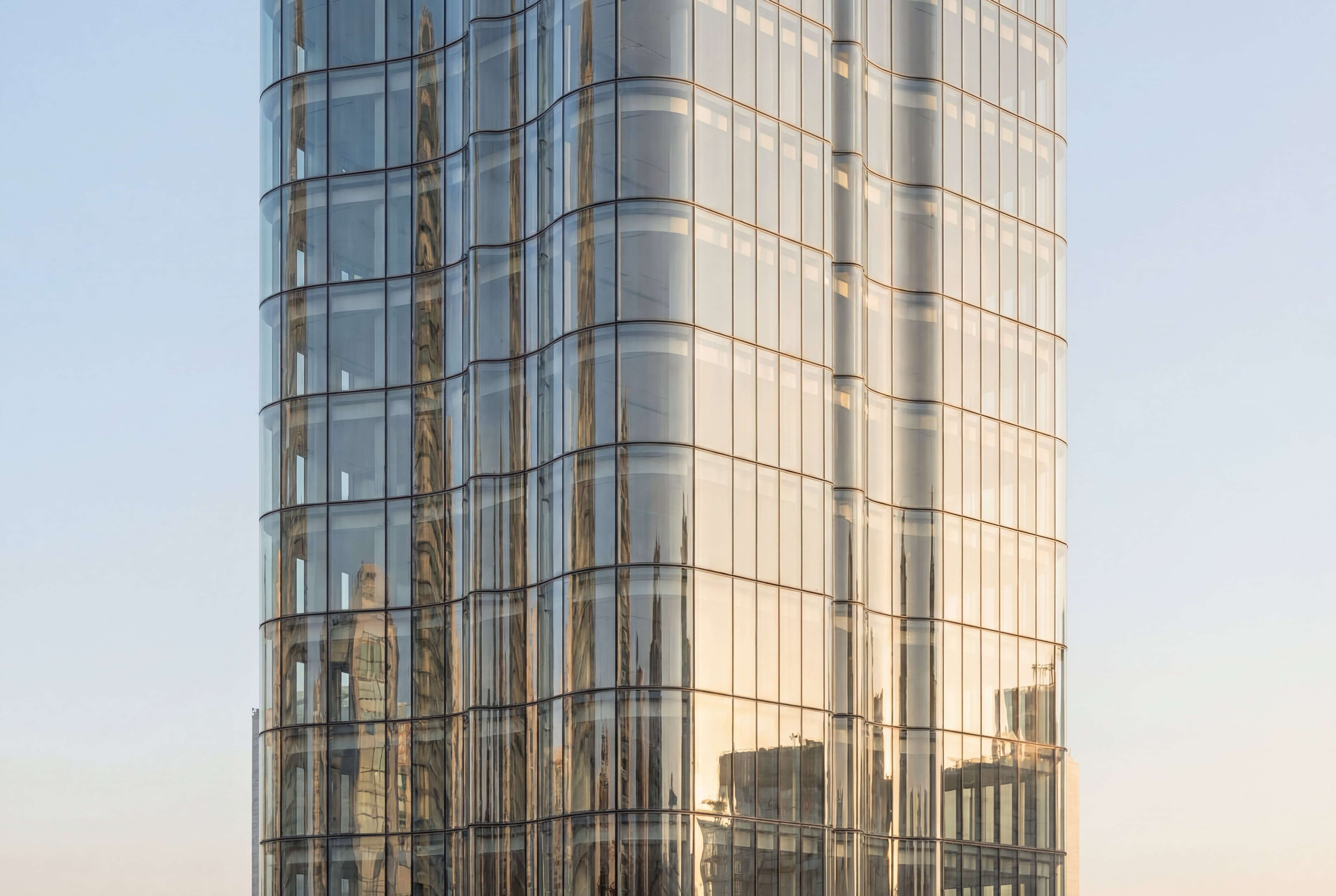
Curved Glass is a high-precision architectural glass solution produced by heating and shaping glass under controlled conditions to achieve the required radius and geometry. In modern architecture, continuous facade continuity, aerodynamic lines, and the creation of a unique identity for the structure are widely used.
Benefits
Design freedom: Enables curved façades, corner returns, cylindrical surfaces, and organic forms with visual continuity.
Enhanced architectural impact: Adds a stronger identity and a “one-piece surface” perception to the building envelope.
Light & reflection control: Curved geometry allows more controlled management of light refraction and reflection behavior.
System compatibility: Suitable for curtain wall systems, stick systems, and project-specific façade details.
Flexible configurations: Can be produced as tempered, laminated, Low-E, Solar Low-E, reflective, ceramic frit printed, and insulating glass (IGU) combinations.
Safety & strength options: Depending on project requirements, safety performance can be enhanced with tempered or heat-strengthened alternatives.
Application Areas
Architectural façades and corner returns
Curtain wall shopfronts / showroom glazing
Iconic buildings such as hotels, malls, and airports
Domes, atriums, canopies, and entrance canopies
Interior applications: glass balustrades, partitions, and bespoke design elements
Production Notes
Curved Glass projects require a combined evaluation of radius, glass thickness, panel size, optical quality, and tolerances.
For solar control coated or reflective glass, thermal stress / thermal breakage risks may occur depending on the application; therefore, correct product selection—and when required tempering or heat-strengthening—is recommended.
For laminated and IGU combinations, the build-up and surface orientation (Surface 1 / Surface 2, etc.) should be defined through an engineering approach based on project requirements.
OTHER PRODUCTS